Tuesday, 10 November 2015

Depth - Image Bank

Depth - Image Bank

This image uses a wide depth of field and this makes the image effective as it allows the viewer to focus on more of the image. I also like the colours which are in the image and like how there is focus to the centre of the image. It is likely that the image was shot with the f/stop value of around f/18.

This image uses wide depth of field. I like this photo because it is in good focus and also like how the light is shining through the trees. This gives an added interest to the image and also the colours make the photograph more eye-catching. I also like how the image shows perspective. It is likely that this image was shot with the f/stop value of around f/22.


This image uses narrow depth of field. I like how this makes only the closest area of the wire stand out. This makes this the main focus point of the image and draws your eye to this area. I also like how the rest of the image is not in focus as this also helps to draw the eye to the focused area of the wire. This image also shows an example of point of focus. It is likely that this image was shot with the f/stop of around f/2.8.


This image also uses narrow depth of field. I like the way that this narrow depth of field only focuses on the mushrooms. This helps to create focus for the centre of the image and also helps focus the eye onto the main focus point of the image. It is likely that this image was captured with the f/stop value being around f/4.

This image uses wide angle to create an image with an altered perspective. I really like how the image is quite symmetrical and like the way that the white colouring of the snow has created shadows and reflections of light within the image. It is likely that this image was shot with the f/stop of around f/22.
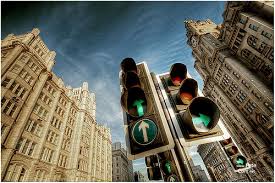

I like this image as it shows an altered perspective by using a wide angle. I like the way that this image has altered the lines of the buildings by curving them slightly. I also like how the traffic lights in the centre of the image adds interest and then draws attention to the centre of the image. It is likely that this image was shot with the f/stop value of around f/22.

Define - Depth

Definitions - Depth

Depth - The distance from the top or surface of something to the bottom of something.

Wide angle - When a camera has a short focal length and hence a field covering a wide angle. This gives a greater perspective than can be seen with the human eye. 

Depth of Field - The amount of distance between the nearest and furthest objects which appear in acceptably sharp focus in a photograph. It is the measure of how much the image is in focus. Depth of field is the sharp area surrounding the point of focus. 

The closer the subject to the camera, the more shallow the depth of field. 
The higher the f/stop, the wider the depth of field.
The lower the f/stop, the narrower the depth of field.


Four Annotated Images

Shallow Depth of Field -


This image shows a shallow depth of field and is effective due to the fact that the eyes are in focus while the rest is not. This helps to make the image more interesting and attracts the viewers eye to the main focus point in the image. It is likely that this image was shot with the f/stop value being around f/5.

This image is very effective as it uses a clear narrow depth of field. I also like how this image has the focused area to one side of the image as this creates a more interesting image. It is likely that this image was shot with f/stop value of around f/4.


Wide Depth of Field -

This image uses a wide depth of field and a wide angle. This allows the image to show more perspective and therefore helps to make the image more interesting. It is likely that the f/stop value was around f/22.

This image uses a wide depth of field and this makes the image more interesting and attracts the eye to more of the image. I also like the way that the image is colourful as it makes the image more attractive and eye-catching. It is likely that the f/stop value was around f/22.


Thursday, 5 November 2015

Movement - Work Diary

Movement - Work Diary

Evaluation

In Thursday's session, we were given the brief of shooting for the topic of movement. I found movement a very difficult subject to capture and at first, found it extremely challenging to take effective photographs. However, as the session went on, I became more familiar as to how the shutter speed affects the image, although still found it to be a challenging task. Below are some examples of images that I captured during the shoot.

This was my favourite image that I captured during the session. I really like how the background is in focus but the bus which is passing by is blurred. For this reason, I think that the image is successful in the presentation of motion and I think that the added edit helps with this. I also like that the blurred element is towards one side of the image as I feel it makes the photograph more eye-catching and appealing.

In my opinion, this is my worst photo from Thursday's shoot. I don't like the image as there are no specifically blurred areas which makes the image look just out of focus and not effective at all. It also makes it look accidental which makes the image very unappealing and poor quality. Also, I do not feel that the image is successful in showing movement as there are too many objects within the image.

Idea Development

Despite the fact that I found shooting for movement very unenjoyable, I found a selection of interesting images which would inspire me if I were to shoot for the topic again. If I were to shoot again, I would be sure to take a tripod to keep the camera steady as I think that this would make for a more quality image. I would also make sure that my images were colourful and portrayed an element of fun. To do this, I would try to go out shooting on a bright and sunny day and also would try to visit an interesting place where some more interesting and eye-catching shots could be captured. Below are some images which I would use for inspiration if I were to shoot for the topic of movement again.


Movement - Straight Images - Best 5

Movement - Straight Images - Best 5

The images below were all taken on 'Shutter Priority' mode using a variety of shutter speeds from 1 second to 7 seconds. These shutter speeds helped me to create the images which showed movement. I used a longer shutter speed for the images where I experimented with light as this helped more of the light to be shown in the image.

This is my original image and I think it shows motion relatively well. With this image, I attempted to show the motion of someone spinning round on a chair. 

I then edited the image to make it more saturated. I like the edited version more than the original as it makes the motion clearer. This was one of my first images that I took during the shoot and for this reason, feel that it turned out quite well. 

I like this image as it experiments with light trails, which I was inspired to investigate due to my previous research on Ian Egner. To create this image, I had to use a relatively slow shutter speed which helped me to capture images and shapes which would usually not be seen.

This is my favourite image as I love the way that the background is in focus while the passing bus is blurred. This creates a very obvious element of motion and allows it to be clear by means of which part of the image is moving.

I then edited the image using photoshop and added a black and white filter as well as increasing the contrast. I think that this edit has helped to focus the eye to the element of motion which is being presented in the image by means of the bus passing by.

With this image, I experimented again using light trails. These light trails which created a shape, were achieved by having a slow shutter speed on the camera. Although I really like the image, I feel that it could be improved with the use of a tripod.

I then edited the image on photoshop and put a black and white filter on the image. This allowed the light trails to stand out more to be more striking and catch the viewers eye and in this way, allows them to become the main point of focus in the image.


Here, I again used a slow shutter speed to create shapes in the image which one would not usually see. In the image, the light trails are exaggerated more by the darker background and therefore catch the viewers eye. I also like how in this image, there are multiple light trails which adds interest to the image.
Movement Contact Sheet


Movement - Image Bank

Movement - Image Bank

I really like how this image portrays the motion of spinning and like the way that the blur of the photo shows that a spinning motion was going on. I also like the colours in the image as I feel that they make the areas of blur more obvious which therefore helps to draw your eye to the areas where motion is being portrayed.

I think this image shows motion very well and I like how there are many blurred figures in the photograph but only the first is in focus. I also like the element of the dark background as I think this helps to attract the viewer to the element of motion as it makes the figure very eye-catching.

I really like this image as I think that it portrays motion and speed. I really like how the background and the horse's legs are blurred as this creates the feeling of fast movement. I also like how some of the horse is in focus as this allows the viewer to be drawn to this as the main focus point in the image. The image was captured by photographer Christopher Martin, who looks at images of motion and the blurring of images.

This photo was captured by photographer Ian Egner. He focuses on light trails which are created by long exposure photography. This shows motion in a more unconventional form but in my opinion, the image above is very successful in creating the theme of movement and is a very interesting image.

This image is also by Ian Egner. I really like the image as it is very interesting and appealing to the eye. It presents movement by the lines of light which are created in the road. The image is also very appealing as the colours are very striking and bold.

This image was taken  by JJ. Lartigue. It is a different sort of image than the ones which look at motion expressed by blurring. However, I think that the image clearly shows the motion of the wave which is made especially obvious with the black and white filter which has been added.

Define - Movement

Define - Movement

Movement - The action or process of moving or being moved. Related to motion.

Four annotated images

This image shows movement in the form of the duck's wings. I like how the body is still but the wings are blurred. This makes the image successful in creating the feel of movement within the image.


This image shows movement well as the blurred areas show the lines of motion. I think that this creates a more obvious representation of movement.

I really like this image as it shows the movement of water which is quite original and unique. I also like the colours in the image as I feel it draws the viewers eye more to the image. 


This image shows movement well due to the lines which are coming off the figures. These look especially effective due to the fact that the bright colours are on a black background which makes them stand out more.